
Where to Invest Money in Canada: Best Options for 2026
Not sure where to put your money? Here are the best places to invest in Canada — from ETFs and stocks to GICs, real estate, and high-interest savings accounts. Organized by risk level and timeline.

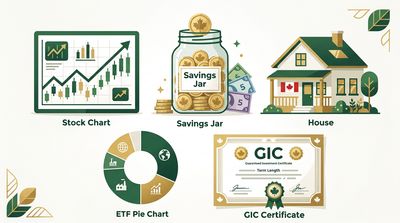
You have money sitting in a savings account earning 3-4%. You know you should invest it. But the options feel overwhelming — stocks, ETFs, bonds, GICs, real estate, crypto. Where do you actually put your money?
This guide cuts through the noise. We will organize every investment option available to Canadians by risk level and timeline, so you can match your money to your goals.
The Framework: Match Your Timeline to Your Risk
Before choosing where to invest, you need to answer one question: when do you need this money?
| Timeline | Risk Tolerance | Best Options | Expected Return |
|---|---|---|---|
| Under 1 year | Very low | HISA, money market funds | 3-4% |
| 1-3 years | Low | GICs, short-term bond ETFs | 3-5% |
| 3-5 years | Moderate | Balanced ETFs (60/40), GIC ladder | 4-6% |
| 5-15 years | Moderate-High | Growth ETFs (80/20), dividend stocks | 6-8% |
| 15+ years | High | All-equity ETFs (100% stocks) | 8-10% |
The longer your timeline, the more risk you can take. Risk is not bad — it is the price you pay for higher returns. Over long periods, the stock market has always recovered from downturns.

Best Places to Invest Money in Canada (By Risk Level)
1. High-Interest Savings Accounts (Lowest Risk)
Best for: Emergency fund, money you need within 12 months
A high-interest savings account (HISA) is not really "investing" — it is parking your money safely while earning some interest. But it is the right choice for money you cannot afford to lose.
Current top rates (2026):
- EQ Bank — 2.50-3.00% (no minimum, no fees)
- Tangerine — 1.00-5.50% (promotional rates for new deposits)
- Wealthsimple Cash — 3.50-4.00% (with premium subscription)
- Simplii Financial — 1.50-5.25% (promotional rates)
Canadian-specific tip: Look for HISA offerings inside a TFSA. Interest earned in a TFSA-HISA is completely tax-free. EQ Bank and several credit unions offer TFSA savings accounts at competitive rates.
2. GICs — Guaranteed Investment Certificates (Low Risk)
Best for: Money you need in 1-5 years, risk-averse investors
GICs guarantee your principal plus a fixed interest rate. You lock your money in for a set term (typically 1-5 years). The trade-off is liquidity — you usually cannot access the money before maturity without a penalty.
Why GICs work for short-term goals:
- Your principal is guaranteed and CDIC-insured up to $100,000
- Rates are currently competitive (4-5% for 1-year terms)
- No market risk — your balance never drops
- Predictable returns make them ideal for saving toward a specific date (down payment, tuition)
GIC ladder strategy: Instead of locking all your money in one 5-year GIC, split it across 1, 2, 3, 4, and 5-year terms. Each year, one GIC matures — giving you regular access to funds while capturing longer-term rates.
3. Bond ETFs (Low-Moderate Risk)
Best for: Conservative investors, portfolio diversification, 3-5 year timelines
Bond ETFs hold hundreds of government and corporate bonds in a single fund. They provide stability and income, though they can lose value when interest rates rise.
Top Canadian bond ETFs:
- ZAG (BMO Aggregate Bond Index ETF) — Broad Canadian bond market, MER 0.09%
- XBB (iShares Core Canadian Universe Bond) — Similar broad coverage, MER 0.10%
- VSB (Vanguard Canadian Short-Term Bond) — Lower interest rate risk, MER 0.11%
4. All-in-One ETFs (Moderate-High Risk — Best for Most People)
Best for: Beginners, long-term investors, anyone who wants simplicity
All-in-one ETFs are the single best option for most Canadian investors. One purchase gives you instant diversification across thousands of stocks and bonds worldwide. The portfolio automatically rebalances itself.
If I could give one piece of investment advice to every Canadian, it would be this: buy a single all-in-one ETF in a TFSA and set up automatic contributions. Done. You have just beaten most actively managed mutual funds and most stock pickers. The simplicity is the feature, not a limitation.
Top all-in-one ETFs in Canada:
| ETF | Allocation | MER | Risk Level | Best For |
|---|---|---|---|---|
| VCNS | 40% stocks / 60% bonds | 0.24% | Conservative | 3-10 year timeline |
| VBAL / XBAL | 60% stocks / 40% bonds | 0.24% / 0.20% | Balanced | 5-15 year timeline |
| VGRO / XGRO | 80% stocks / 20% bonds | 0.24% / 0.20% | Growth | 10-20+ year timeline |
| VEQT / XEQT | 100% stocks / 0% bonds | 0.24% / 0.20% | Aggressive | 15-30+ year timeline |
James and Priya had $65,000 in a bank mutual fund charging 2.1% MER. After reading about index investing, they moved everything to VGRO (0.24% MER) at Questrade. The fee difference of 1.86% doesn't sound like much, but on their portfolio — growing with $1,000/month contributions — it adds up to approximately $47,000 in savings over 25 years. That is an extra $47,000 in their retirement fund from a single afternoon of paperwork.
5. Individual Stocks (Higher Risk)
Best for: Experienced investors, those willing to research companies
Buying individual stocks means owning a piece of a specific company. The potential returns are higher than ETFs, but so is the risk — a single company can drop 50% or go bankrupt.
If you buy individual stocks in Canada, consider:
- Canadian bank stocks (RY, TD, BNS, BMO, CM, NA) — Historically stable, strong dividends
- Canadian pipeline/utility stocks (ENB, TRP, FTS, CU) — Steady dividends, lower volatility
- Canadian REITs (CAR.UN, REI.UN, HR.UN) — Real estate exposure with dividend income
Important: Do not put more than 5-10% of your portfolio in any single stock. Diversification protects you from company-specific risk. If you want stock exposure, an ETF is the safer way to get it.
6. Real Estate (High Risk, High Capital Required)
Best for: Those with significant capital, long-term investors comfortable with illiquidity
Real estate investing in Canada goes beyond buying a rental property. Options include:
- Principal residence — Your home is not an investment strategy, but it is tax-free on sale
- Rental property — Requires significant capital ($50,000+ for a down payment in most markets), management effort, and carries concentration risk
- REITs (Real Estate Investment Trusts) — Buy real estate exposure through the stock market for as little as $20. No property management, no tenants, instant diversification
- Real estate ETFs — Funds like ZRE (BMO Equal Weight REITs) hold dozens of Canadian REITs in one purchase
Canadian housing context: With average home prices above $700,000 nationally and over $1 million in Toronto and Vancouver, direct real estate investment requires substantial capital. REITs offer real estate exposure without the six-figure down payment.
7. Cryptocurrency (Very High Risk)
Best for: Speculative allocation only — 1-5% of portfolio maximum
Cryptocurrency is not a core investment strategy. It is a speculative asset class with extreme volatility. Bitcoin has dropped 70%+ multiple times.
If you choose to allocate a small portion to crypto:
- Use a Canadian-regulated platform (Wealthsimple Crypto, Bitbuy, Newton)
- Never invest more than you can afford to lose entirely
- Hold in a non-registered account (crypto is not eligible for TFSA or RRSP)
- Be aware that crypto gains are taxable as capital gains in Canada
Where NOT to Invest Your Money
Avoid these common traps:
- High-fee mutual funds — Most bank mutual funds charge 2%+ MER. Over 30 years, that costs you 30-40% of your potential returns. Use low-cost ETFs instead.
- Forex/day trading — 70-80% of retail traders lose money. This is speculation, not investing.
- Penny stocks — Extremely risky, often manipulated. Stick to established companies or ETFs.
- "Guaranteed" high returns — If someone promises 15%+ annual returns with no risk, it is a scam. Always verify with the CSA (Canadian Securities Administrators).
How to Get Started (5 Simple Steps)
When do you need this money? Under 5 years → GICs/HISA. Over 5 years → ETFs. Over 15 years → growth/equity ETFs.
Most Canadians should start with a TFSA. See our complete guide to investment accounts for the decision framework.
Wealthsimple (easiest, $0 commissions) or Questrade (lowest cost for active investors). Takes 15 minutes online.
VGRO or XGRO for most people with 10+ year timelines. One purchase, instant diversification, done.
Even $25/week ($100/month) adds up. Automatic investing removes emotion and builds wealth through dollar-cost averaging.
Account comparison, brokerage comparison, and model portfolios — all in one free PDF.
Learn More
- How to Start Investing in Canada: Beginner's Guide — Our complete pillar guide
- TFSA Guide: Everything You Need to Know — Deep dive on Canada's most flexible account
- ETF Investing in Canada — All-in-one ETFs, fees, and portfolio construction
- Investment Accounts in Canada Explained — Every account type compared
Frequently Asked Questions
Get the Canadian Investing Starter Kit — free
Account types, brokerage comparison, and your first portfolio blueprint.
No spam. Unsubscribe anytime. PIPEDA compliant.
Related Guides
How to Start Investing in Canada: A Beginner's Guide
A complete beginner's guide to investing in Canada. Learn about account types, investment options,...
ETF Investing in Canada: A Complete Beginner's Guide
Everything you need to know about ETF investing in Canada. Covers all-in-one ETFs, Canadian vs US...