
Best Investing Apps for Beginners in Canada (2026)
Compare the best investing apps in Canada for 2026. Honest breakdown of fees, features, account types, and mobile experience for Wealthsimple, Questrade, Interactive Brokers, and more.

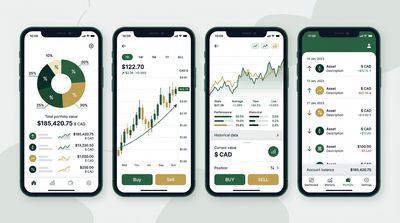
Choosing the right investing app is one of the first decisions new Canadian investors face — and it matters more than most people think. The wrong platform can cost you hundreds of dollars a year in unnecessary fees, while the right one removes friction and makes it easier to build a consistent investing habit.
I have tested every major Canadian brokerage app over the past several years. This guide covers the platforms that are actually worth your time in 2026, with honest assessments of their strengths and weaknesses.
Every brokerage in this guide is regulated by the Canadian Investment Regulatory Organization (CIRO) and is a member of the Canadian Investor Protection Fund (CIPF). Your investments are protected up to $1 million per account category if the brokerage becomes insolvent.
What Makes a Good Investing App for Beginners?
Before comparing platforms, it helps to know what actually matters. For Canadian beginners, these five factors should drive your decision:
- Fees — Commission costs, currency conversion, and account fees
- Account types — TFSA, RRSP, FHSA, and non-registered support
- Investment selection — Canadian and US stocks, ETFs, bonds, GICs
- Mobile experience — Interface quality, reliability, and feature completeness
- Education and support — Learning resources and customer service quality
The best platform for a beginner is the one that gets you investing consistently. Low fees matter, but not if a confusing interface means you never make your second deposit. Find the app that feels intuitive to you and start there.
The 7 Best Investing Apps in Canada for 2026
| Platform | Stock/ETF Commissions | USD Conversion Fee | Account Minimum | Fractional Shares | TFSA/RRSP/FHSA |
|---|---|---|---|---|---|
| Wealthsimple | $0 | 1.5% (0% with Premium) | $0 | Yes | Yes |
| Questrade | $0 ETF buys / $4.95–$9.95 stocks | 2% (or Norbert's Gambit) | $1,000 | No | Yes |
| Interactive Brokers | $0.01/share (min $1) | ~0.2% (spot rate) | $0 | Yes | Yes |
| TD Direct Investing | $9.99/trade | 1.5% | $0 | No | Yes |
| BMO InvestorLine | $9.95/trade | 1.5% | $0 | No | Yes |
| National Bank Direct Brokerage | $0 | 1.5% | $0 | No | Yes |
| CI Direct Trading | $0 | 1.5% | $0 | No | Yes |
1. Wealthsimple — Best Overall for Beginners
Wealthsimple is the most popular investing app in Canada for a reason. It removed the barriers that kept most Canadians from investing: no commissions, no minimums, no confusing interfaces.
What you get:
- Commission-free trading on all Canadian and US stocks and ETFs
- Fractional shares starting at $1
- TFSA, RRSP, FHSA, RESP, and non-registered accounts
- Automated round-ups, recurring deposits, and robo-advisor portfolios
- Crypto trading (separate from investment accounts)
The trade-off: USD currency conversion costs 1.5% each way on the free tier. If you plan to buy a lot of US stocks, that adds up. The Premium plan ($10/month or free with $100,000+) eliminates this fee entirely.
If you are only buying Canadian-listed ETFs like XEQT, VEQT, or XGRO, Wealthsimple's currency conversion fee is irrelevant — these are traded in Canadian dollars. For most beginners following a simple ETF investing strategy, Wealthsimple is hard to beat.
Best for: Complete beginners, small account sizes, hands-off investors who want the simplest possible experience.
2. Questrade — Best for ETF Investors
Questrade pioneered low-cost investing in Canada and remains a strong choice, especially for ETF-focused portfolios. Buying ETFs is free, and the platform offers more advanced tools than Wealthsimple.
What you get:
- Free ETF purchases (you pay commission only when selling)
- Stock trading from $4.95 to $9.95 per trade
- Questrade Edge platform for more advanced charting and research
- TFSA, RRSP, FHSA, RESP, LIRA, and corporate accounts
- Norbert's Gambit support for cheap USD conversion
The trade-off: The interface feels dated compared to Wealthsimple. Stock commissions apply to individual stock trades. The $1,000 minimum deposit can be a hurdle for some beginners, though it can be waived if you set up a pre-authorized contribution of $50/month.
Best for: Investors focused on building an all-ETF portfolio who want slightly more control than Wealthsimple offers.
3. Interactive Brokers — Best for Low-Cost USD Trading
Interactive Brokers is the choice for cost-conscious investors who trade US stocks frequently. Its currency conversion is essentially at the spot rate — a massive advantage over every other Canadian platform.
What you get:
- Near-zero currency conversion (~0.2% vs 1.5% elsewhere)
- Access to global markets (US, Europe, Asia)
- The lowest margin rates in Canada
- Fractional shares on US stocks
- TFSA, RRSP, and non-registered accounts
The trade-off: The interface is built for professionals, not beginners. The learning curve is steep. Customer support is minimal. Account setup is more complex with identity verification sometimes taking days.
Interactive Brokers now offers IBKR GlobalTrader, a simplified mobile app aimed at beginners. It is friendlier than the full Trader Workstation but still has a steeper learning curve than Wealthsimple or Questrade.
Best for: Investors who buy US stocks regularly and want the absolute lowest currency conversion costs.
4. National Bank Direct Brokerage — Best Free Bank Brokerage
National Bank made headlines in 2021 by dropping commissions to zero — a first among Canadian bank-owned brokerages. It remains the only major bank brokerage with free stock and ETF trading.
What you get:
- $0 commissions on all stock and ETF trades
- Full access to Canadian and US markets
- TFSA, RRSP, FHSA, RESP, and non-registered accounts
- Backed by one of Canada's Big Six banks
The trade-off: The app and platform are functional but not elegant. Research tools are basic. Currency conversion still costs around 1.5%. Customer support is better than discount brokerages but slower than the big five banks.
Best for: Investors who want commission-free trading with the security and trust of a major Canadian bank.
5. CI Direct Trading (formerly Virtual Brokers) — Commission-Free Alternative
CI Direct Trading offers commission-free trading and is backed by CI Financial, one of Canada's largest independent asset managers.
What you get:
- $0 commissions on stock and ETF trades
- TFSA, RRSP, FHSA, and non-registered accounts
- Access to CI's lineup of ETFs and mutual funds
- Financial planning tools
The trade-off: The platform is less polished than Wealthsimple. Name recognition is lower, and the user base is smaller, which means fewer community resources and reviews. Currency conversion fees apply for USD trades.
Best for: Investors who want commission-free trading and prefer a platform backed by a large, established Canadian financial institution.
6. TD Direct Investing — Best for Full-Service Features
TD Direct Investing is the largest discount brokerage in Canada by assets. It offers the broadest research tools and deepest integration with TD banking.
What you get:
- Advanced research tools, analyst reports, and screeners
- TD GoalAssist robo-advisor option
- Seamless integration with TD bank accounts (instant transfers)
- TFSA, RRSP, FHSA, RESP, RIF, and corporate accounts
- In-branch support at any TD location
The trade-off: $9.99 per trade is expensive in 2026. The mobile app has improved but still feels heavy compared to Wealthsimple. The platform makes more sense if you already bank with TD.
Best for: TD banking customers who value integrated banking, research tools, and the option for in-person support.
7. BMO InvestorLine — Solid Bank Brokerage Option
BMO InvestorLine is similar to TD Direct Investing — a full-featured bank brokerage with higher commissions but stronger research and support.
What you get:
- adviceDirect option for portfolio guidance
- Robust research tools and analyst reports
- BMO SmartFolio robo-advisor integration
- Full suite of registered and non-registered accounts
- BMO banking integration
The trade-off: $9.95 per trade. The app is functional but not best-in-class. Like TD, it works best if you already bank with BMO.
Best for: BMO banking customers who want investing integrated into their existing banking relationship.
How to Choose: Recommendations by Investor Type
Sarah had never invested before and felt overwhelmed by options. She chose Wealthsimple because there was no minimum deposit, and she could start with $50. She set up automatic bi-weekly contributions into a single all-in-one ETF (XEQT) inside her TFSA. The entire process took 15 minutes on her phone.
Here is who I recommend each platform for:
Choose Wealthsimple. Zero commissions, no minimum, fractional shares, and the best mobile experience in Canada. Open a TFSA, set up automatic deposits, and buy an all-in-one ETF like XEQT or VEQT. You can always move to another platform later — for free, once you hit $5,000 (Wealthsimple covers the transfer fee).
Choose Questrade. Free ETF purchases, a wider range of account types, and more advanced tools as you grow. The $1,000 minimum is a minor hurdle — set up a $50/month pre-authorized contribution to waive it.
Choose Interactive Brokers. The ~0.2% currency conversion rate saves you hundreds compared to the 1.5% charged by most Canadian platforms. If you are buying $10,000 worth of US stocks, that is $150 saved at IBKR versus Wealthsimple's free tier.
Choose National Bank Direct Brokerage. Zero commissions and Big Six bank backing. The trade-off is a less polished app and basic research tools.
Stick with your bank's brokerage. TD Direct Investing and BMO InvestorLine are more expensive per trade, but the convenience of instant transfers, in-branch support, and a single login may be worth it — especially if you trade infrequently.
I tell my clients to stop agonizing over which platform to pick. The difference between Wealthsimple and Questrade on a $25,000 portfolio is maybe $30 to $50 a year. The difference between investing and not investing is tens of thousands of dollars over a decade. Open an account, fund it, and start.
Fees That Actually Matter (and Ones That Don't)
Commission-free trading gets all the headlines, but the fees that quietly erode your returns are elsewhere:
Currency conversion is the biggest hidden cost for Canadian investors. If you buy $5,000 worth of US-listed stocks or ETFs on a platform charging 1.5% each way, you pay $75 to buy and $75 to sell — $150 gone before your investment earns a cent. Use Canadian-listed ETFs (like XEQT or VFV) to avoid this entirely, or choose Interactive Brokers if you want direct US exposure.
Fees to watch:
- Currency conversion: 1.5% each way at most Canadian brokerages. IBKR charges ~0.2%.
- MERs (Management Expense Ratios): The annual fee on ETFs and mutual funds. XEQT charges 0.20% — on a $10,000 portfolio, that is $20/year. Actively managed mutual funds charge 1.5–2.5%, or $150–$250 on the same amount.
- Account transfer fees: Most brokerages charge $150 to transfer your account out. Wealthsimple and some others will reimburse this if you transfer in $5,000+.
- Inactivity fees: Rare now, but some platforms still charge if your account is dormant. Questrade eliminated theirs. Check before you sign up.
In Canada, all investment income inside a TFSA is completely tax-free — including dividends, capital gains, and interest. This makes your choice of account type even more important than your choice of platform. Open a TFSA first, then worry about which app to use.
What About Robo-Advisors?
Several platforms on this list also offer robo-advisor services — automated portfolio management where the platform picks and rebalances your investments for you:
- Wealthsimple Managed — 0.5% management fee (on top of ETF MERs). Good for truly hands-off investors.
- Questwealth — 0.25% management fee. Lower cost but fewer features.
- TD GoalAssist — 0.5% management fee. Available within TD Direct Investing.
- BMO SmartFolio — 0.7% management fee. Higher cost with no clear advantage.
For most beginners, buying a single all-in-one ETF (like XEQT or VGRO) inside a self-directed account gives you the same diversification at a fraction of the cost. A robo-advisor charging 0.5% on a $50,000 portfolio costs $250/year. Buying XEQT yourself costs $100/year in MERs and zero in trading fees on Wealthsimple.
How to Open Your First Investment Account
If you are ready to start, here is the process — it takes about 15 minutes on any platform:
Based on the recommendations above, pick the app that fits your situation. For most beginners, that is Wealthsimple.
The TFSA is the best starting account for most Canadians. Your investments grow tax-free, and you can withdraw anytime without penalty. See our complete TFSA guide for contribution limits and strategies.
Link your bank account and set up a recurring deposit. Even $25 every two weeks adds up to $650 a year. Automation is the most reliable way to build an investing habit.
For beginners, a single all-in-one ETF like XEQT (100% equity) or VBAL (60/40 balanced) provides instant diversification across thousands of global stocks and bonds. Learn more in our ETF investing guide.
Canada's FHSA (First Home Savings Account) launched in 2023 and is available at all major brokerages. If you are saving for your first home, you can contribute up to $8,000/year (up to $40,000 lifetime), get a tax deduction on contributions, and withdraw tax-free for a home purchase. It combines the best features of the TFSA and RRSP. Check our investing basics guide for more on how it fits into your plan.
Common Mistakes to Avoid
After watching thousands of Canadians open their first investment accounts, these are the errors I see most often:
- Paying $9.95/trade on a $500 portfolio. If you are investing small amounts, use a commission-free platform. A $9.95 trade on a $500 investment is an immediate 2% loss.
- Buying US-listed ETFs when Canadian versions exist. VFV (Canadian-listed, in CAD) gives you the same S&P 500 exposure as VOO (US-listed, in USD) without the currency conversion fee.
- Opening a non-registered account before maxing registered accounts. Always fill your TFSA first, then RRSP. The tax savings compound dramatically over time.
- Chasing the "perfect" platform instead of starting. The cost of waiting a year to invest $10,000 is far greater than any fee difference between platforms.
- Ignoring MERs on mutual funds. Your bank will happily sell you a mutual fund charging 2.2% annually. On $50,000, that is $1,100/year vs $100/year for a comparable ETF.
The Bottom Line
The Canadian investing app landscape in 2026 is the best it has ever been. Commission-free trading is now the norm, account minimums are disappearing, and the mobile experience keeps improving.
For most beginners: open a Wealthsimple TFSA, set up automatic deposits, and buy XEQT. That single decision puts you ahead of the vast majority of Canadians who are still sitting on the sidelines or paying high mutual fund fees at their bank.
As your portfolio grows and your needs become more complex, you can explore platforms like Questrade for more advanced tools or Interactive Brokers for cheaper US stock access. But the most important step is the first one.
For a full breakdown of how investing works in Canada and which accounts to open, start with those guides. And if you are wondering where to put your money right now, we have covered that too.
A step-by-step checklist for opening your first TFSA, picking your first ETF, and setting up automated contributions — designed specifically for Canadian beginners.
Frequently Asked Questions
Get the Canadian Investing Starter Kit — free
Account types, brokerage comparison, and your first portfolio blueprint.
No spam. Unsubscribe anytime. PIPEDA compliant.
Related Guides
How to Start Investing in Canada: A Beginner's Guide
A complete beginner's guide to investing in Canada. Learn about account types, investment options,...
ETF Investing in Canada: A Complete Beginner's Guide
Everything you need to know about ETF investing in Canada. Covers all-in-one ETFs, Canadian vs US...